Breeding Locally Adapted Fruit Trees
Why grow from seed?
For a variety of reasons, I don't want to spray pesticides on my farm. For the health of my family, for the health of the natural ecosystem, financial reasons, and because of how difficult and time-consuming it can be.
I've spent several years collecting a wide range of different varieties to see which ones will do best in my climate and with my growing style. After trying different things and learning more about growing without pesticides I decided the next natural step would be to start growing my own seedlings in hopes of finding even better varieties suited to my specific growing conditions. I use the varieties that I have collected as the breeding stock for my future fruit trees.
Starting seeds outside
One of the primary techniques that I’m using is to start my seeds directly outdoors instead of inside like many plant breeders do. It’s only a theory, but I believe starting seed indoors under artificial conditions will not yield the best varieties for growing in my climate without pesticides. Starting seeds directly outdoors in the natural elements has some advantages that interest me.
- The seeds will be cold stratified by nature and will be automatically tuned to the lows and highs of a winter in my climate.
- The weakest seeds that are not suitable for my climate will not survive the winter. This results in lower germination rates than if starting the seeds indoors, but the resulting seedlings will be more adapted to my conditions.
- The seedlings that are able survive with the natural moisture provided will be more capable of growing without irrigation.
- Minimizing transplant shock. Seeds started directly outdoors in their nursery bed will not need to be transplanted until they are tall enough to graft onto dwarfing rootstock in the trial rows.
- The taproot. Seeds started directly outdoors can put a taproot down as deep as they like without the risk of the taproot being broken during transplanting. I believe this will result in a healthier seedling that can reach grafting size sooner.
Population Breeding
With a goal of creating locally adapted varieties that can survive my local growing conditions without the need for pesticides, I would like to lean more towards population breeding rather than pedigree breeding. While I’m not certain that I can generate, and have enough space to grow, the necessary volume for true population breeding, I plan to work in that direction. These are some of the techniques I use.
- Collecting a wide variety of breeding stock to establish a wide genetic diversity as a starting point.
- Seeking out varieties that have not been used as much, or at all, in modern breeding which currently has a lot of in-breeding taking place.
- I will avoid intentional backcrossing for specific traits as is the norm in pedigree breeding and instead focus on larger numbers and variety of mostly open-pollinated seeds.
- I will seek out neighbors that are willing to grow some seedlings on their property as well to increase the size of the overall population.
Open Pollination
While I am growing some intentional crosses, the majority of the seedlings will be open pollinated. My preference for open pollinated seedlings is for a couple of reasons.
First, I think that open pollinated will give me the best mix of pollen and thus the largest amount of diversity. This is part of my goal with population breeding. I think with hand pollination there is the long-term potential to decrease diversity if not done correctly and with the largest mix of pollen.
Second, I believe that open pollinated seedlings also match my goal of locally adapted fruit trees. Open pollinated means that the seeds were successfully pollinated by the local pollinators I have available in my area. I do not keep honeybees, nor do any of my neighbors that I have found. The pollinators I see in my orchards are a variety of native bees, butterflies, wasps, and small flies to name a few. If a tree is successful at being pollinated by the insects available, then I think it increases the likelihood that the seedlings can achieve reasonable yields without outside pollinators.
Speeding up fruiting
I hope to get my seedling trees to fruit as quickly as possible so I can test more varieties and achieve as many generations as I reasonably can. The techniques I'm experimenting with are:
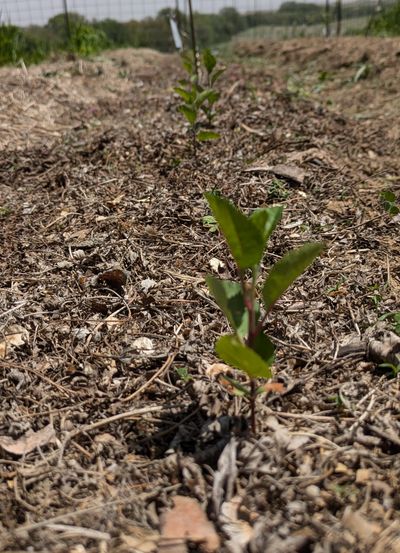
- Growing the seedlings outdoors does seem to produce impressive first-year growth. I think this is due to an undisturbed tap root and avoiding transplant shock. Of course, the weather outside is more variable and in some years it may be a liability, but overall I think it's an advantage.
- I'm grafting some of the seedlings onto dwarfing rootstock which is a technique used by many private breeders to induce precocity in the tree. I'm mostly using Bud9 rootstock for this purpose. I'm following some published data that suggests apples in particular are capable of exiting the juvenile stage once they reach the 80-100 node range. I graft from the top of the seedling tree in order to use the most mature nodes. Some vigorous seedlings reach this range int he first year, allowing for dormant grafts the following spring.
- I recently became aware of an old technique that was used by Russian plant breeder Ivan Michurin in the late 1800's and early 1900's. His process was to graft a branch from a bearing variety into the crown of the seedling tree to induce early fruiting. Michurin felt that grafting seedlings onto dwarf rootstock produced inferior fruit compared to fruit that was produced on the seedling tree. I plan to compare this method to grafting on dwarf trees.
- A third hybrid approach I'm testing for space saving reasons, is to graft the seedling onto a mature tree, and then once the seedling branch grows to a sufficient length, I will graft a scion from a mature fruiting tree toward the end of the seedling branch. This works on the idea that changes to the shoot apical meristem can induce flowering, similar to Michurin's method of grafting into the canopy of a seedling tree.
Growing some permanent seedlings
In addition to growing large numbers of seedlings in nursery rows I am also intentionally starting some seedlings in permanent locations. A large part of this is to satisfy my own curiosity in seeing an apple tree grow undisturbed in its permanent home.
Of course, this means that I might be stuck with a large tree full of apples that have limited culinary use but that’s a chance I’m willing to take. Growing seedlings should include some beauty and wonder to keep us interested.
This is my current technique for starting permanent seedling trees.
- In late fall/early winter I prepare the location of the seedling tree.
- I plant 15 to 20 seeds in this area and lightly mulch
- I protect the area around the seeds with hardware cloth to keep mice, voles, and deer from disturbing them.
- I let whichever seeds sprout grow for the next season, and then I choose one seedling to leave in that spot to grow undisturbed and with a full intact root system.
- The remaining seedlings are removed and if any look worth keeping I graft them onto dwarf rootstock in a trial row.
Food Security over Marketability
My primary goal in growing seedlings is food security. I think locally adapted trees capable of being grown without pesticides is the best way to achieve this goal. While it would be nice to find a tree that is resilient and the best tasting fruit you have ever eaten, this is not my primary concern. I prioritize the health and local suitability of the fruit above amazing and complex flavors. In other words, I would choose an average tasting apple that can be grown without pesticides over the best tasting fruit ever that cannot live without external inputs.
I hope to create trees that can be grown by local families to provide reliable and nutritious food. I’m not breeding trees for the commercial apple market, or even for home growers in far off parts of the country. Interested people in other parts of the country, and across the world, should be growing their own locally adapted fruit trees.
To that end I am happy to share my trees and seeds as basis for people that want to start their own local breeding program.